
The Field Guide Nobody Gave You
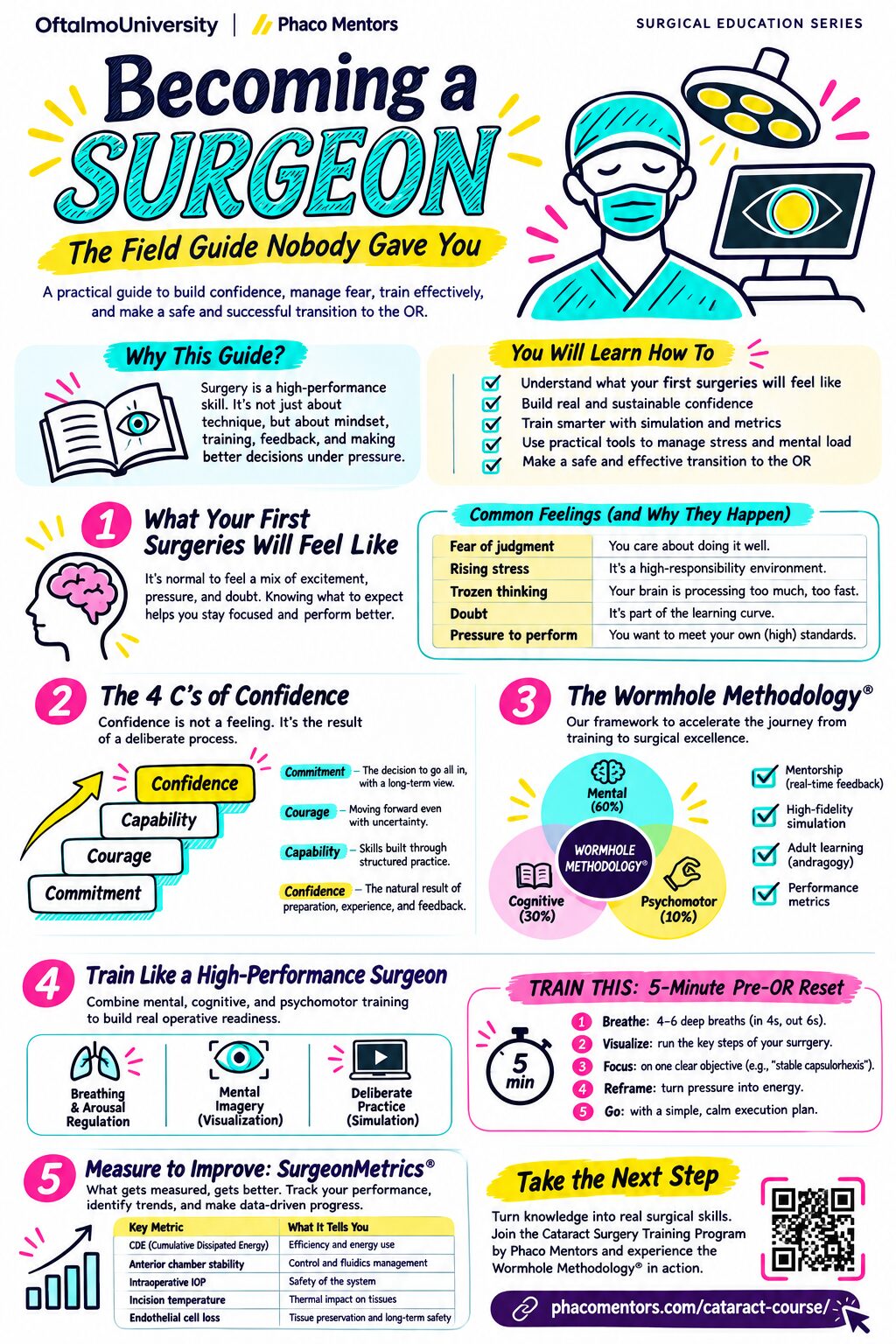
What does it really mean to become a surgeon? It means learning to manage uncertainty, accepting feedback, earning confidence through preparation and putting the patient’s safety above your ego.
Today I had a conversation with a young doctor trying to find her path toward becoming a surgeon. We did not spend most of our time talking about instruments, surgical steps or phacodynamics. We talked about fear. About being judged. About the pressure of a real patient beneath the microscope. And about the question nearly every surgeon has asked, sometimes in silence: Am I ready?
Surgery can be the most rewarding profession in the world and one of the most emotionally demanding. The same hands that restore vision can, on another day, face a complication that challenges everything we believe about our abilities. Both experiences belong to the same profession.
“The goal is not to become a surgeon who never feels fear. It is to become a surgeon who knows how to prepare, respond and ask for help.”
CHAPTER 01What your first surgeries may feel like
The first cases can bring a powerful contradiction: you know the steps, yet the presence of a patient, a mentor and an observing team changes the experience. Your breathing may become shallow. Your shoulders tighten. You become aware of every movement. A simple step suddenly demands tremendous mental effort.
Stress can narrow attention and consume working memory. You may hesitate, lose your place or momentarily freeze. These responses are not proof that you are incapable. They are signals that your preparation must include cognitive and mental performance, not only manual skill.
“The operating room will test much more than your hands.”
| What you may experience | What to recognize | Trainable response |
|---|---|---|
| Fear of judgment | Attention shifts from the patient to how you are perceived | Instructional self-talk and feedback practice |
| Overload | Too many simultaneous decisions | Chunking and a clear next-step plan |
| Freezing | Hesitation or loss of situation awareness | Stop unsafe movement, call the mentor, reassess |
| Uncertainty | Pressure to continue despite doubt | Explicit stop criteria and early help-seeking |
CHAPTER 02Judgment, ego and the courage to be coachable
You will be observed. You will be corrected. Sometimes the feedback will be generous; sometimes it will be uncomfortable. Learn to separate a performance from your identity. A difficult capsulorhexis does not define you as a person, but it does provide information about what to practice next.
Coachability is the ability to seek feedback, process it without reflexive defensiveness, and demonstrate a measurable change in the next attempt. Humility is not a lack of ambition. It is the condition that allows ambition to become excellence.
“Feedback is not a verdict about who you are. It is information about what you can improve.”
After a simulation or supervised case, write down: (1) one action that went well, (2) one observable error, (3) the probable cause, and (4) one drill for the next session.
CHAPTER 03The four C’s: how confidence is actually built
Dan Sullivan’s four-C framework offers a useful model: Commitment, Courage, Capability and Confidence. You decide that the goal matters. You accept the discomfort of learning. You build competence through deliberate, supervised practice. Only then does confidence begin to become grounded.
In surgery, this framework requires one essential modification: courage must never be confused with taking risks beyond your competence. Sometimes the most courageous decision is to pause, request assistance or transfer control.
Before your next session, define one skill you will demonstrate, one metric you will record and one condition under which you will ask for help.
CHAPTER 04Train your mind as seriously as your hands
Mental rehearsal, attentional control, relaxation, self-talk and simulation under progressively challenging conditions can be practiced. Randomized surgical training studies suggest comprehensive mental-skills curricula can reduce performance deterioration under stress. Evidence for any isolated technique in ophthalmic microsurgery is still limited, so we should teach these tools without promising that they prevent complications.
| Strategy | How to rehearse it | Best moment |
|---|---|---|
| Breathing reset | Three to five gentle, unforced slower breaths; exhale slightly longer than inhale | Before scrubbing or at a safe pause |
| Grounding | Feel feet on floor, check posture, reconnect with the operative view | When attention drifts into self-judgment |
| Instructional self-talk | Use a short task cue: “Clear view. Stable chamber. Next safe step.” | Before a demanding step |
| Mental imagery | Rehearse the anatomy, sequence, complication recognition and help request | Before the case and during simulation |
| If–then plans | “If I lose orientation, I stop unnecessary movement and call my mentor.” | During prebriefing |
| Stress exposure | Introduce realistic distractions gradually after baseline skill is established | In simulation, with supervision |
20 s: settle your breath. 15 s: orient to posture and anatomy. 25 s: mentally rehearse the next step. 15 s: choose an instructional cue. 15 s: confirm stop criteria and mentor availability.
CHAPTER 05The bridge from simulation to the operating room
Simulation changes where a surgeon can make many of their earliest mistakes. We can repeat a maneuver, analyze errors, rehearse a complication and receive objective feedback without making a patient carry that part of the learning curve. But a successful simulator score is not a license for unsupervised surgery.
The transition to real surgery should be its own structured educational phase: demonstrated foundational competence, appropriate case selection, face-to-face supervision, progressive autonomy, predefined intervention criteria and reflective review.
“The operating room should not be the first place you discover a basic technical limitation that simulation could have revealed.”
CHAPTER 06What to do when your mind freezes: RESET
A trainee who freezes needs a rehearsed safety behavior, not an instruction to “just relax.” RESET is a proposed educational mnemonic, not a validated clinical algorithm. It should be practiced in simulation and adapted to the clinical situation and the supervising surgeon’s protocols.
| Step | Action |
|---|---|
| R · Recognize | Notice hesitation, confusion, tunnel vision or loss of the surgical plan. |
| E · Establish safety | Stop unnecessary instrument movement and maintain operative safety. |
| S · Seek support | State the problem clearly and request mentor intervention early. |
| E · Evaluate | Re-establish visualization, anatomy and the next safe action. |
| T · Transition | Resume only when appropriate and authorized; otherwise hand over control. |
If an active complication requires immediate treatment, coping techniques must never delay clinical intervention or mentor takeover.
Have a mentor introduce an unexpected change during a controlled simulation. Practice stating the problem aloud, stopping unsafe movement and requesting help. Debrief what happened before repeating.
CHAPTER 07Complications, recovery and the hidden emotional cost
Surgeons carry memories that never appear on a CV. A complication may lead to guilt, shame, sleeplessness or a loss of confidence. The right response is neither denial nor self-punishment. First care for the patient; then review honestly, disclose and document according to institutional requirements, seek peer and professional support when needed, and plan targeted retraining.
Being resilient does not mean being unaffected. Nor does excellent surgery require sacrificing family life and mental health without limits. Sustainable performance includes recovery, honest conversations, support systems and the ability to say that you need help.
“Responsibility helps us learn. Shame, when left unaddressed, can make us hide.”
Ask: What happened? What did I notice? What influenced my decision? What will change before my next case? Who should review the case with me?
CHAPTER 08The Wormhole Methodology: from potential to measurable progress
At OftalmoUniversity and Phacomentors, the educational ambition behind the Wormhole Methodology is to connect mentorship, high-fidelity simulation, cognitive preparation, psychological support, performance practice and objective feedback. The pathway combines online learning and mentor guidance, simulator and artificial-eye training, and appropriately supervised clinical surgery.
The program’s mental-performance component can incorporate psychological support, guided breathing videos, imagery exercises and personalized coping plans. Performance metrics, including work developed with Tomás, help learners see trends, understand the causes of errors and select their next deliberate-practice target. These are descriptions of the educational approach, not claims that the complete methodology has been independently proven superior in a clinical trial.
| Dimension | Example training target | How progress can be observed |
|---|---|---|
| Psychomotor | Precision, stability, controlled instrument use | Simulator performance, video review, rubric-based assessment |
| Cognitive | Anticipation, decision-making, complication recognition | Scenario scoring and mentor feedback |
| Mental | Attention, pressure regulation, recovery from disruption | Structured scenarios and validated workload/anxiety instruments |
| Clinical | Patient-centered safety and results | Supervised operative assessments and risk-adjusted outcomes |
For cataract surgery, useful measures may include cumulative dissipated energy (CDE), anterior chamber stability, incision-related parameters, and postoperative clinical results. Metrics must be interpreted in context: a single number cannot establish overall surgical competence.
CHAPTER 09The journey: seven deliberate moves
- Understand the responsibility before chasing the title.
- Find a mentor who observes and tells you the truth.
- Learn to receive feedback without defending your identity.
- Build technical and cognitive foundations in simulation.
- Train pressure regulation and rehearsed responses to difficulty.
- Enter the OR through supervised, competency-based progression.
- Keep measuring, reflecting and training throughout your career.
The point is not to make the journey easy. It is to make it more intelligent, supportive and safer. Excellence is not a feeling we declare. It is a discipline we demonstrate, review and rebuild over time.
“Become the surgeon you would trust with the vision of someone you love.”
Your next step starts before the OR
Explore a structured cataract training pathway combining mentorship, simulation and supervised operative progression. Connect with the Phacomentors team and learn about training with Dr. Ivo Ferreira.
Explore the Cataract Surgery Training ProgramEvidence and further reading
- Ferris JD et al. EyeSi access and cataract complications. British Journal of Ophthalmology, 2020. Observational database study.
- Stefanidis D et al. Comprehensive mental-skills curriculum. American Journal of Surgery, 2017. Randomized trial.
- Anton NE et al. Mental skills training under stress. American Journal of Surgery, 2018. Randomized trial.
- Phacomentors. Cataract Course and Wormhole program structure. Official program page.
Educational note: Training strategies and the RESET mnemonic are teaching tools, not substitutes for clinical protocols, supervision or patient-specific judgment. The precise benefit of individual coping techniques in ophthalmic microsurgery remains under investigation.